Agent Skills Ecosystem Map: A Data-Driven Look at 25M Workers and 50K skills
AI tooling is booming but only for developers. We measured the democratization gap across 25M workers and found most professions locked out of the composable AI ecosystem.
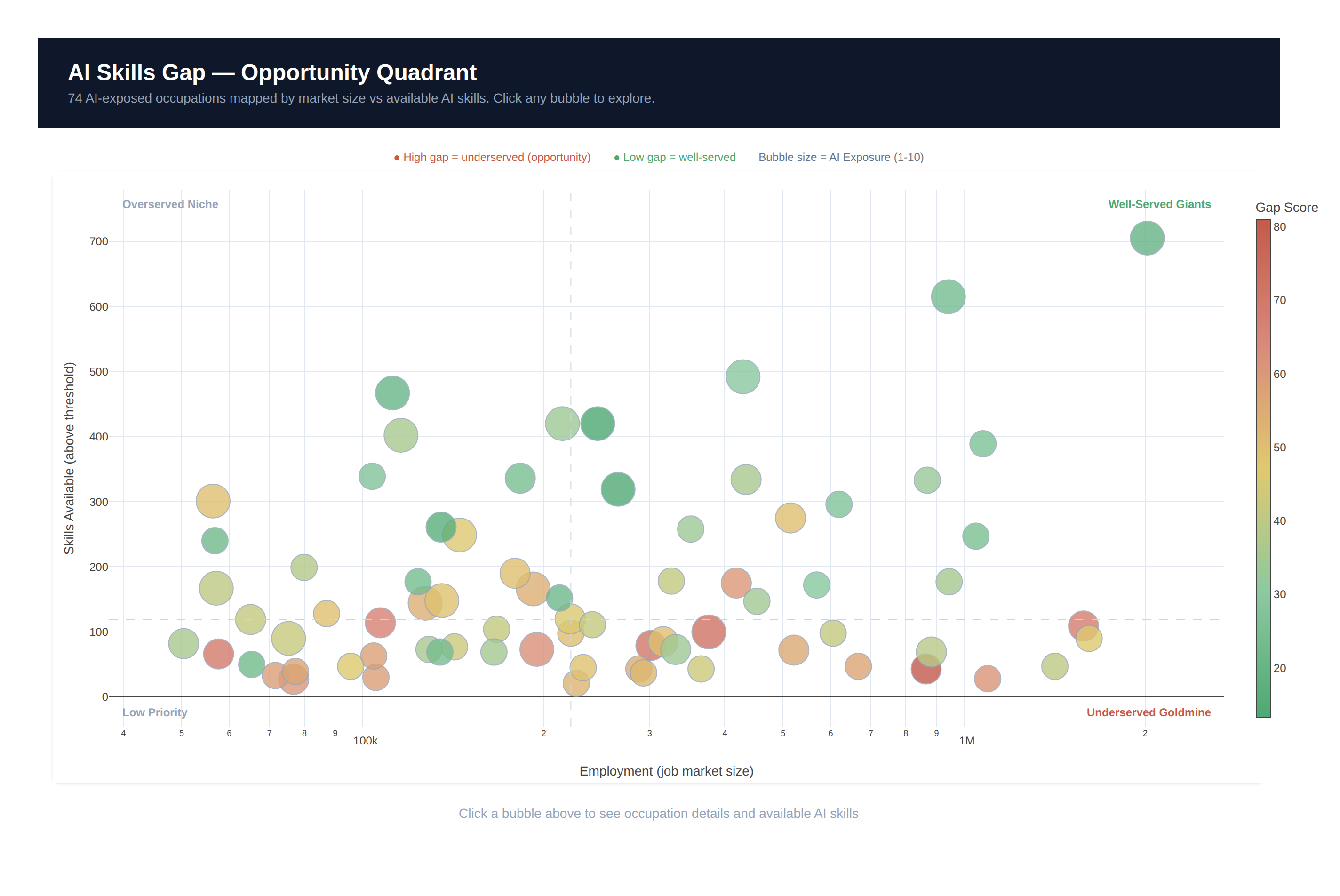
TL;DR: Skills Marketplace Explorer for AgentSkills Ecosystem mapped onto the US workforce. Click the bubbles, explore.
Big companies are racing to serve every profession with AI. There is a difference, however, between “a big vendor built something for you” and having an ecosystem of builders who can extend models for specialized tasks. Today, on one end of the spectrum we see software developers. They don’t just have AI, they are building skills, MCP servers and more and the entire ecosystem around AI, accelerating the adoption and gains they see from the technology. On the other side of the spectrum - lawyers, accountants, teachers - they still heavily rely on what the vendor has shipped.
We wanted to measure how deep this democratization gap goes. So we looked at 74 US occupations, 85,000 Reddit posts from 167 profession-specific subreddits, and 47,000 AI skills - and mapped who has tools, who doesn’t, and who wants them.
Results
The Underserved
| Rank | Occupation | Gap Score | AI Appetite | Exposure | Jobs |
|---|---|---|---|---|---|
| 1 | Lawyers | 81.0 | 4/10 | 9 | 813K |
| 2 | Paralegals & legal assistants | 71.9 | 3/10 | 8 | 345K |
| 3 | Loan officers | 70.6 | 2/10 | 8 | 310K |
| 4 | Tax examiners & collectors | 69.2 | 3/10 | 9 | 68K |
| 5 | Accountants & auditors | 68.4 | 8/10 | 8 | 1.5M |
Legal is the widest gap. Two legal professions in the top 3 - high exposure, growing curiosity, but the open skills ecosystem barely touches them. Yes, Harvey AI and CoCounsel exist, but those are closed enterprise products. A solo practitioner or small firm can’t browse a marketplace and plug in a “contract review” skill the way a developer installs a GitHub Actions skill. Combined ~1.2M workers without an ecosystem.
Accountants are the volume story. 1.5M jobs, highest appetite in the top tier (8/10). They’re actively asking for automation on Reddit - proposal writing, tax prep, reconciliation. Big vendors (Intuit, Thomson Reuters) are building, but there’s much less in the open/composable layer.
The Democratization Extreme
No surprises here. Software developers with hundreds of skills. This is what a fully democratized ecosystem looks like - anyone can build, anyone can install, tools compose together. Every other profession is a fraction of this missing a bazaar where they can try and build skills which are missing with ease.
Sector Patterns
- Legal: Consistently the widest gap across roles (lawyers, paralegals, compliance). The profession most in need of democratized tools.
- Finance: Mixed - accountants are underserved in the open layer, financial analysts better served (more overlap with developer-adjacent data tools)
- Education: Moderate gap, teachers want grading/planning/feedback tools - workflows that big EdTech hasn’t automated well
- Healthcare-adjacent: Medical records specialists have high gap; clinical roles are harder to serve with open tools due to compliance requirements
Interactive Explorer
Explore all 74 occupations in the interactive visualization - click any bubble to see the occupation’s AI exposure rationale, gap breakdown, and every mapped skill.
Details of analysis
Data
| Source | What | Link |
|---|---|---|
| Karpathy Framework (JoshKale/jobs) | AI exposure scores for all 342 occupations | github.com/JoshKale/jobs |
| Arctic Shift | Reddit monthly scrape of top 40K subreddits, Feb 2026 (41.4M posts) | arctic-shift.photon-reddit.com |
| ClawHub | ~42,000 AI agent skills registry | clawhub.ai |
| skills.sh | ~9,500 AI skills directory | skills.sh |
- Karpathy’s US Job Market. Narrowed down to those with top AI exposure, meaningful market size (50,000+) and median pay > $50,000 as a proxy for affordability of AI solutions. This covers about 25M of workers across 74 occupations.
- Reddit Feb 2026 posts filtered down to subreddits linked to the occupations enriched with last year searches for common AI keywords - brands and broader terms. Positive karma only.
- Scrape of skills across ClawHub, skills.sh, normalized and deduplicated: ~47,000 skills. These represent the democratized layer - composable, installable tools anyone can use. Not the enterprise products from big vendors. We’re measuring the ecosystem, not the incumbents.
Methodology
Match skills to occupations through cosine similarity. Top skills additionally ranked by LLM with relevance score. Sentiment analysis through a sample of posts labeled by LLM.
Three percentile-ranked components (0-100 each):
| Component | Measures | Source |
|---|---|---|
| Exposure Rank | How much AI can disrupt this work | Karpathy framework |
| Demand Rank | How much workers want AI tools | Reddit engagement × AI appetite × tasks wanted |
| Supply Gap Rank | How few open tools exist | Inverse of matched skill count + quality |
Final score = geometric mean of the three ranks. Geometric mean requires strength across all three dimensions - a profession must be exposed, have real demand, and lack supply to score high.
Limitations
- Reddit skews younger/more-online; professions with older demographics may be underrepresented
- Supply measured from open registries only - enterprise/vertical SaaS products are intentionally excluded
- Karpathy exposure scores reflect AI capability potential, not current adoption
- BLS occupation categories don’t always match professional self-identity
So What?
AI technology works for everyone, but the ecosystem - the open, composable, tinker-friendly layer is heavily skewed to software developers. Big vendors will keep building vertically integrated solutions. But the real unlock is the same thing that happened with software development over the past decade: an open ecosystem where anyone can build a tool, anyone can install it, and tools compose together.
Legal, accounting, education, healthcare administration - these professions represent millions of workers doing highly AI-automatable tasks with essentially zero access to the composable tooling that developers take for granted.